
land grading Brush Prairie WA planning should begin with the finished property, not with the first machine task. Owners often call because trees, standing water, rough ground, a failed driveway or an underground route is blocking progress. The visible issue matters, but the lasting result depends on what comes next: a home, shop, utility, septic system, landscape, access road or drainage outlet. A site-specific plan connects today’s excavation work to that long-term use.
Acre Maker provides professional land grading services for homeowners, builders and property owners across Southwest Washington. The team can evaluate the property, clarify the groundwork scope and coordinate related clearing, grading, access, trenching or excavation. Property owners can request a project estimate after gathering any plans, surveys, utility information and jurisdictional requirements available for the site.
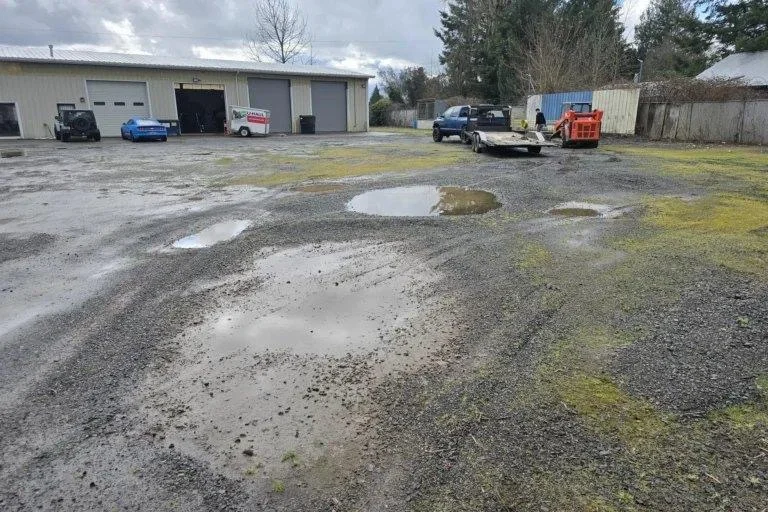
Standing water and deteriorated gravel show that drainage must be corrected before resurfacing. Image source: Acre Maker website
Why land grading Brush Prairie WA Requires a Property-Specific Plan
Brush Prairie properties often include large lawns, gravel drives, outbuildings and relatively subtle elevation changes. A difference that is difficult to see can still hold water for days. Wet-season observation, elevations and soil conditions are more useful than simply filling the lowest visible spot.
The practical questions are consistent: What must remain protected? Where can equipment travel? Which elevations are fixed? Where will water go? What material is suitable for reuse? What inspections or approvals occur before work is covered? Answering those questions early helps a Brush Prairie, WA property move from an isolated excavation task to a coordinated, buildable result.
1. A Low Spot Has No Positive Outlet
The first useful step is to define the outcome before moving equipment. On a Brush Prairie, WA property, water reaches a depression but the surrounding grades rise in every direction. During the site walk, the contractor should shoot elevations from the low area to roadside ditches, swales, native ground and other possible outlets. That information helps determine the equipment, access route, material handling, and order of operations needed for the work. For a land grading Brush Prairie WA project, this early evaluation is especially important because the visible problem is often connected to drainage, soil condition, buried infrastructure, or a future phase of construction.
A sound recommendation is to reshape the area only after confirming a legal and stable place for water to travel. The scope should identify what will be removed or reshaped, what will remain protected, where excavated material will go, and what condition the area should be in at handoff. If the plan skips that level of detail, added fill may push water toward a building, neighbor or another low area. Clear benchmarks also make it easier to coordinate land grading with surveyors, builders, utility providers, septic professionals, or landscape crews without repeating work.
2. The Surface Slopes Toward a Building
A dependable plan separates what is visible on the surface from what controls performance below it. On a Brush Prairie, WA property, settlement, landscaping changes or previous fill can direct runoff toward foundations and slabs. During the site walk, the contractor should check grades at walls, crawlspace vents, patios, garage doors and downspout discharge points. That information helps determine the equipment, access route, material handling, and order of operations needed for the work. For a land grading Brush Prairie WA project, this early evaluation is especially important because the visible problem is often connected to drainage, soil condition, buried infrastructure, or a future phase of construction.
A sound recommendation is to restore positive drainage away from structures while preserving required clearances. The scope should identify what will be removed or reshaped, what will remain protected, where excavated material will go, and what condition the area should be in at handoff. If the plan skips that level of detail, moisture can remain against foundations or enter low openings during heavy rain. Clear benchmarks also make it easier to coordinate land grading with surveyors, builders, utility providers, septic professionals, or landscape crews without repeating work.
3. Compacted Soil Limits Infiltration
This decision should be made during field evaluation, not after excavation has already started. On a Brush Prairie, WA property, traffic and equipment can compress the upper soil so rainfall ponds even where the surface appears flat. During the site walk, the contractor should compare wet and dry areas, identify traffic patterns and evaluate whether subsoil or imported material is restricting infiltration. That information helps determine the equipment, access route, material handling, and order of operations needed for the work. For a land grading Brush Prairie WA project, this early evaluation is especially important because the visible problem is often connected to drainage, soil condition, buried infrastructure, or a future phase of construction.
A sound recommendation is to combine surface grading with appropriate soil improvement or drainage where infiltration alone is insufficient. The scope should identify what will be removed or reshaped, what will remain protected, where excavated material will go, and what condition the area should be in at handoff. If the plan skips that level of detail, regrading only the top inch may create the same puddles after the first wet season. Clear benchmarks also make it easier to coordinate land grading with surveyors, builders, utility providers, septic professionals, or landscape crews without repeating work.
4. A Driveway Acts Like a Dam
The goal is not simply to move soil or material; it is to create a site that supports the next phase. On a Brush Prairie, WA property, raised gravel edges and compacted base can interrupt the natural downhill path of shallow runoff. During the site walk, the contractor should trace water on both sides of the drive and inspect culverts, cross drains and shoulder elevations. That information helps determine the equipment, access route, material handling, and order of operations needed for the work. For a land grading Brush Prairie WA project, this early evaluation is especially important because the visible problem is often connected to drainage, soil condition, buried infrastructure, or a future phase of construction.
A sound recommendation is to provide controlled crossings or reshape shoulders without weakening the travel surface. The scope should identify what will be removed or reshaped, what will remain protected, where excavated material will go, and what condition the area should be in at handoff. If the plan skips that level of detail, water can pond on the uphill side, saturate the base and create potholes. Clear benchmarks also make it easier to coordinate land grading with surveyors, builders, utility providers, septic professionals, or landscape crews without repeating work.

Field elevation checks help determine how water can move across a property. Image source: Acre Maker website
5. Roof and Hard-Surface Runoff Is Concentrated
Good site work is measured by how well the property functions after the equipment leaves. On a Brush Prairie, WA property, downspouts, patios and roofs deliver water faster than surrounding soil can absorb it. During the site walk, the contractor should map every concentrated discharge and observe whether it reaches a stable outlet. That information helps determine the equipment, access route, material handling, and order of operations needed for the work. For a land grading Brush Prairie WA project, this early evaluation is especially important because the visible problem is often connected to drainage, soil condition, buried infrastructure, or a future phase of construction.
A sound recommendation is to separate roof-runoff management from broad yard grading and coordinate both systems. The scope should identify what will be removed or reshaped, what will remain protected, where excavated material will go, and what condition the area should be in at handoff. If the plan skips that level of detail, a small discharge point can erode new grades or overwhelm a shallow swale. Clear benchmarks also make it easier to coordinate land grading with surveyors, builders, utility providers, septic professionals, or landscape crews without repeating work.
6. The Property Was Graded in Isolated Patches
A practical scope connects today’s work to the driveway, building, utility, drainage, or landscape work that follows. On a Brush Prairie, WA property, multiple small repairs can create ridges, abrupt transitions and disconnected drainage areas. During the site walk, the contractor should review the property as one watershed rather than one puddle at a time. That information helps determine the equipment, access route, material handling, and order of operations needed for the work. For a land grading Brush Prairie WA project, this early evaluation is especially important because the visible problem is often connected to drainage, soil condition, buried infrastructure, or a future phase of construction.
A sound recommendation is to develop a continuous grading plan that shows high points, flow lines, collection areas and outlets. The scope should identify what will be removed or reshaped, what will remain protected, where excavated material will go, and what condition the area should be in at handoff. If the plan skips that level of detail, fixing one wet area may simply move the problem a few yards away. Clear benchmarks also make it easier to coordinate land grading with surveyors, builders, utility providers, septic professionals, or landscape crews without repeating work.
7. Soil and Seasonal Conditions Were Not Considered
The best time to solve this issue is while access, elevations, and equipment sequencing are still flexible. On a Brush Prairie, WA property, a surface that performs in August may remain saturated when groundwater and rainfall are high. During the site walk, the contractor should evaluate during or soon after wet weather and review available soil information. That information helps determine the equipment, access route, material handling, and order of operations needed for the work. For a land grading Brush Prairie WA project, this early evaluation is especially important because the visible problem is often connected to drainage, soil condition, buried infrastructure, or a future phase of construction.
A sound recommendation is to design for the season when the property is most vulnerable, not just the day of construction. The scope should identify what will be removed or reshaped, what will remain protected, where excavated material will go, and what condition the area should be in at handoff. If the plan skips that level of detail, the solution may appear successful until the next extended rain. Clear benchmarks also make it easier to coordinate land grading with surveyors, builders, utility providers, septic professionals, or landscape crews without repeating work.
8. Erosion Protection Was Left Out
A written field plan gives the owner and contractor the same definition of a finished result. On a Brush Prairie, WA property, newly moved soil is most vulnerable before vegetation or surfacing is established. During the site walk, the contractor should identify slopes, discharge points and bare areas that need temporary and permanent stabilization. That information helps determine the equipment, access route, material handling, and order of operations needed for the work. For a land grading Brush Prairie WA project, this early evaluation is especially important because the visible problem is often connected to drainage, soil condition, buried infrastructure, or a future phase of construction.
A sound recommendation is to include erosion control, topsoil placement, seeding, rock or other finish measures in the scope. The scope should identify what will be removed or reshaped, what will remain protected, where excavated material will go, and what condition the area should be in at handoff. If the plan skips that level of detail, runoff can cut channels into the new grade and carry sediment off site. Clear benchmarks also make it easier to coordinate land grading with surveyors, builders, utility providers, septic professionals, or landscape crews without repeating work.
How Acre Maker Approaches Land Grading Projects
Acre Maker evaluates grading as a water-and-elevation problem, not merely a request to make an area look smooth. The site walk should identify high points, low points, runoff sources, soil condition, outlets, structures and future improvements. Measurements and a clear finish plan guide where soil is cut, placed, compacted or removed.
The work should also include temporary drainage and stabilization so the property remains functional between rough grading and final landscaping or construction. When drainage, driveway and site-preparation work overlap, one coordinated plan helps every surface connect.
Learn more about Acre Maker’s start-to-finish groundwork services and the company’s commitment to local communication and dependable field work on the About Acre Maker page.
What a Complete Contractor Proposal Should Address
A useful proposal for land grading Brush Prairie WA should define limits, quantities, exclusions and the condition of the finished site. Look for descriptions of mobilization, access, protection, clearing or excavation limits, soil and material handling, import or export, drainage, compaction, cleanup and restoration. The proposal should identify owner-provided information, permit responsibility, utility locating, inspections, schedule assumptions and conditions that could trigger a documented change. Comparing that scope is more reliable than comparing a single price with no shared definition of completion.
Ask how weather, unsuitable soil, buried debris, rock, groundwater, unmarked private utilities or design changes will be handled. A contractor cannot eliminate every unknown below the surface, but the agreement can establish communication, documentation and decision-making procedures before those unknowns affect the work.
A Practical land grading Brush Prairie WA Planning Checklist
- Observe the property during or just after rain.
- Map roof, driveway and uphill runoff sources.
- Measure elevations rather than relying only on appearance.
- Identify a safe, lawful drainage outlet.
- Check compacted traffic areas and imported fill.
- Review driveway crossings and culverts.
- Plan stabilization for all disturbed soil.
- Confirm permits or engineering requirements before work.
Frequently Asked Questions
Will adding topsoil fix standing water?
Only when the underlying elevations and outlet are correct. Adding material without a drainage plan may move the water or create new problems.
Does every wet area need a French drain?
No. Some areas need regrading, some need a swale or outlet, and some require an underground system. Diagnosis should come first.
Can gravel driveways cause yard drainage problems?
Yes. A raised or poorly drained driveway can block sheet flow and hold water on the uphill side.
When is the best time to evaluate drainage?
During the wet season or immediately after meaningful rain, when flow paths and saturated areas are visible.
Can Acre Maker grade around existing buildings?
Often, yes. The available space, foundation clearances, utilities and discharge route must be evaluated before selecting the approach.
Plan Your Brush Prairie, WA Groundwork With Acre Maker
Successful land grading Brush Prairie WA work creates more than a temporary visual improvement. It should make the property safer, easier to build on, better drained and ready for the next trade or long-term use. Acre Maker helps Southwest Washington property owners connect field conditions with a clear scope for land grading. To discuss the property, intended use and next steps, contact Acre Maker for a project estimate.
External Sources
- Clark County – Erosion Control
- Washington State Department of Ecology – Construction Stormwater Permit
- WSU Extension Clark County – Improving Drainage
Image Credits
- land grading Brush Prairie WA standing water and gravel drainage problems – Acre Maker website
- Brush Prairie land grading evaluation with laser level – Acre Maker website